
France is rioting… again. But why?
While the Fifth Republic remains a functioning democracy, its resilience is far from guaranteed.
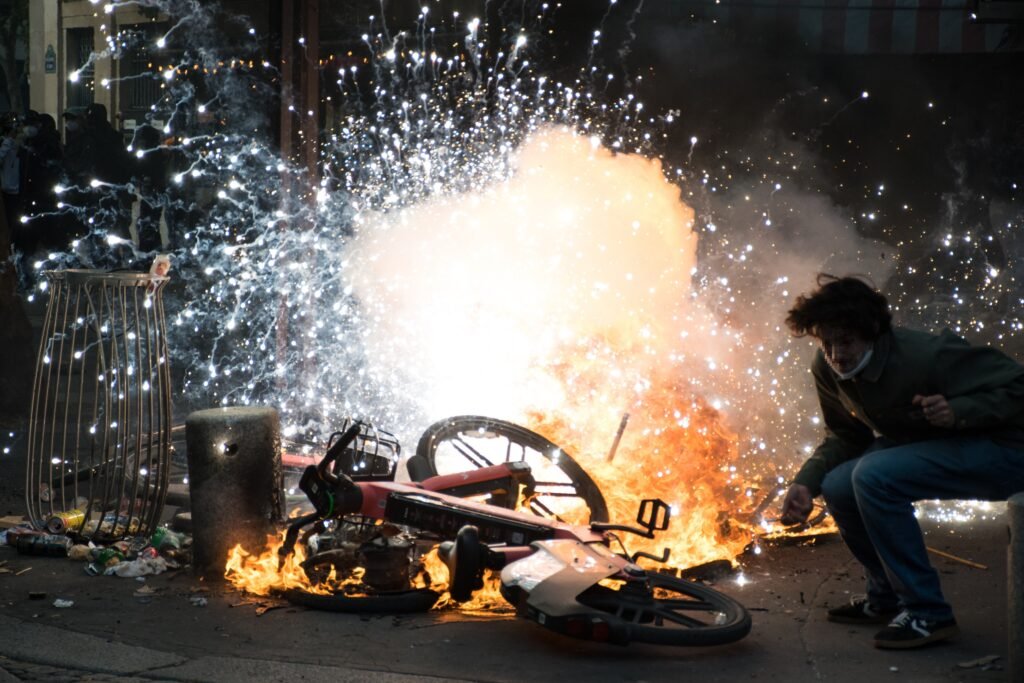
Over the past few weeks, France has returned to its revolutionary roots, with hundreds of thousands of people taking to the streets, protesting and even rioting about the current economic and political climate of the country. What started in September as a row over staff shortages at one high school near Paris has turned into a national movement. Students have blockaded their schools, the yellow vests are back out on Saturdays, and the nationwide strike on 5 November closed around a third of France’s high schools and ended in clashes with police in several cities. Of course, these issues aren’t unique to France, and in fact resonate strongly with 21st-century democracies. The most recent instalment of French republicanism, the Fifth Republic, was established in 1958 to provide stability after decades of political unrest, yet it is increasingly being overwhelmed by the issues it was designed to temper. These include rising polarisation, the ascent of anti-system parties, declining trust in institutions, social unrest, identity conflict and inequality. So it’s vital to talk through why these riots are taking place, rather than just talk about them.

Polarisation and political realignment
Political scientists widely agree that democratic resilience requires a certain degree of civic unity, and a willingness to accept political rivals as legitimate (Levitsky & Ziblatt, 2018). Recent developments in France indicate a sharp erosion of this common ground. Election results since 2017 show a huge reshuffle of political alignments, with the traditional centre-left and centre-right parties losing ground to both the far left and the far right. In the first round of the 2022 presidential election, the Socialist candidate won just 1.75% of the vote and the Republican candidate 4.78%, while Marine Le Pen and Jean-Luc Mélenchon took over 45% between them.
This can be explained through systemic polarisation, which poses particular risks compared with normal political disagreement. As McCoy, Rahman and Somer (2018) argue, it creates “us versus them” blocs that block compromise, reduce trust and speed up democratic erosion. France shows several signs of this, such as deep divides between cities and the countryside, generational splits, and sustained hostility between political camps. In this environment, political opponents are increasingly framed not as natural opposites but as threats, and that makes consensus much harder to reach.
Anti-system parties
The rise of anti-system parties further complicates France’s political landscape. Populist actors can undermine institutional norms even while winning power through elections (Mudde & Kaltwasser, 2017). In France, the National Rally and France Insoumise have become increasingly mainstream, often framing their platforms around distrust of existing institutions, criticism of “elite” governance and calls for major constitutional change. These movements come from legitimate grievances, but they also show what Levitsky and Ziblatt (2018) warn about, where democratic norms are worn down slowly from within the system. The National Rally has relentlessly challenged the legitimacy of the courts, the independence of the media and the European legal order. France Insoumise goes as far as calling for a Sixth Republic, which would completely reshape the executive and parliament. Political change isn’t dangerous in itself, but Ginsburg and Huq (2018) warn that anti-system actors can use constitutional change to lock in their own power. The growing normalisation of these movements shows just how fragile the Fifth Republic has become.
A crisis of trust
Trust in political institutions is a central indicator of democratic health. Fukuyama (2014) identifies institutional trust as the foundation of political legitimacy, and in France it is falling fast. The OECD’s latest Trust Survey found that only 22% of people in France trusted their national government in 2025, down from 34% two years earlier and well below the OECD average of 40%. Only 15% trust political parties (OECD, 2026). France’s own CEVIPOF barometer at Sciences Po found that in early 2026 just 23% of French people thought democracy was working well, and trust in the president and political parties was at its lowest since 2009 (CEVIPOF, 2026). Trust in the police and local mayors is much higher, so the problem is mainly with national politics. Low trust isn’t only a symptom of discontent, it’s a weakness in itself. As Norris and Inglehart (2019) note, declining trust makes people more open to radical narratives, less likely to follow government policy and less willing to accept democratic outcomes.
Power, protest and representation
The Fifth Republic was designed to strengthen the executive after the instability of the Fourth Republic. Yet the concentration of power in the presidency has become increasingly contentious. Critics argue that Article 49.3, which lets the government pass a law without a parliamentary vote on the bill itself, undermines democracy. Élisabeth Borne used it 23 times as prime minister, the most since Michel Rocard in the late 1980s, including to force through the 2023 pension reform. At the time, 80% of French people opposed using 49.3 to pass it (Elabe, 2023). Bermeo (2016) calls this “executive aggrandisement”, where elected leaders slowly weaken the checks on their own power through legal means. While France remains a robust democracy, relying on exceptional powers for this long risks making them normal.
Political unrest is not abnormal for France, even in its most modern history. The yellow vest movement in 2018 and 2019 showed deep disillusionment with political representation, economic inequality and social policy. Later came mass demonstrations against pension reform, and the riots that followed the police killing of Nahel Merzouk in 2023. Habermas (1996) argues that legitimacy in a democracy depends on public debate that people see as fair and responsive, and the scale of recent French protests suggests a real weakness here. Rosanvallon (2008) similarly describes a “crisis of representation” in modern democracies, where institutions no longer connect the state and its citizens. When citizens no longer believe institutions will respond to their needs, the republican order becomes increasingly difficult to maintain.

Identity and inequality
The French republican model is built on laïcité, or strict state secularism. However, how it should be interpreted and applied has become deeply contested. Conflicts over religious expression, especially involving Muslim communities, have become more and more prominent in political debate. Modood (2019) argues that rigid models of secularism can worsen social fragmentation in diverse societies, and France’s identity conflicts reflect this idea. The gap between universal republican ideals and the lived experiences of minority groups creates divisions that weaken social solidarity.
Economic inequality is another structural challenge for the Fifth Republic. Data from Piketty (2014), the OECD and INSEE show consistent gaps between wealthy cities and more rural areas, and things are getting worse. According to INSEE, France’s poverty rate reached 15.4% in 2023, around 9.8 million people and the highest since records began in 1996, and it stayed there in 2024 while inequality hit a 30-year high (INSEE, 2025; 2026). Acemoglu and Robinson (2019) link democratic stability to widespread economic opportunity. Historically, when citizens feel the system is unfair, they become more receptive to radical alternatives or to narratives questioning the legitimacy of the republic itself. Therefore, it could be argued that the rioting in France is not just a result of inequality, but of a discontent so extreme that people are abandoning their commitment to social norms, which are of course vital for any working society.
The future of the Fifth Republic
Growing disparity challenges France far beyond the riots, especially when you consider the calls for a Sixth Republic among supporters of France Insoumise. Constitutional reform could bring democratic renewal, but calls for total political reform also show dissatisfaction with the entire system, and such a radical change could risk democratic collapse. The intensity of the Sixth Republic debate is itself a sign of a system under serious stress.
Therefore, it could be argued that riots are not France’s biggest concern, and rather that they are a symptom of deteriorating democratic conditions around the world, seen in polarisation, institutional distrust, executive overreach, social fragmentation and inequality. While the Fifth Republic remains a functioning democracy, its resilience is far from guaranteed. Preserving the French republican model depends on citizens staying engaged, institutions being reformed and held accountable, and trust being rebuilt across a divided society.
Why France is protesting again
So why is France rioting again? It isn’t about one school, one budget or one reform. Every grievance in this article ends up in the same place. When only a fifth of the country trusts its government, when laws can pass without a vote, when poverty is at a record high and the old parties of the centre have all but vanished, the street starts to feel like the only place people will actually be heard. The Fifth Republic was built to prevent exactly this kind of instability, and the fact that it keeps coming back suggests something in the system has to change. Although, the biggest concern was never identifying these problems, but how to go about fixing them, and that is a whole other discussion.
About the author

Phoebe Allen
Phoebe Allen is a cyber security student currently completing a placement year at Pfizer. In her spare time, she enjoys reading, playing chess and, of course, writing articles.
References
- Acemoglu, D. & Robinson, J. A. (2019). The Narrow Corridor: States, Societies, and the Fate of Liberty. Penguin.
- Associated Press. (2026, 5 November). “Hundreds of thousands strike across France for higher wages and to back students.”
- Bermeo, N. (2016). “On Democratic Backsliding.” Journal of Democracy, 27(1), 5-19.
- CEVIPOF. (2026). Baromètre de la confiance politique, vague 17. Sciences Po / OpinionWay.
- Elabe. (2023, 15 March). Les Français et la réforme des retraites (vague 9). Poll for BFMTV.
- Fukuyama, F. (2014). Political Order and Political Decay. Farrar, Straus and Giroux.
- Ginsburg, T. & Huq, A. (2018). How to Save a Constitutional Democracy. University of Chicago Press.
- Habermas, J. (1996). Between Facts and Norms. Polity Press.
- INSEE. (2025). “Niveau de vie et pauvreté en 2023.” Insee Première, no. 2063.
- INSEE. (2026). “Niveau de vie et pauvreté en 2024.” Insee Première.
- Levitsky, S. & Ziblatt, D. (2018). How Democracies Die. Crown.
- McCoy, J., Rahman, T. & Somer, M. (2018). “Polarization and the Global Crisis of Democracy.” American Behavioral Scientist, 62(1), 16-42.
- Ministère de l’Intérieur. (2022). Résultats de l’élection présidentielle 2022, premier tour.
- Modood, T. (2019). Essays on Secularism and Multiculturalism. Rowman & Littlefield.
- Mudde, C. & Kaltwasser, C. R. (2017). Populism: A Very Short Introduction. Oxford University Press.
- Norris, P. & Inglehart, R. (2019). Cultural Backlash: Trump, Brexit, and Authoritarian Populism. Cambridge University Press.
- OECD. (2026). OECD Survey on Drivers of Trust in Public Institutions, 2026 Results: France. OECD Publishing.
- Piketty, T. (2014). Capital in the Twenty-First Century. Harvard University Press.
- Rosanvallon, P. (2008). Counter-Democracy: Politics in an Age of Distrust. Cambridge University Press.